Jun 2016 - Aug 2016
artnexus #101
Arte in Colombia #147
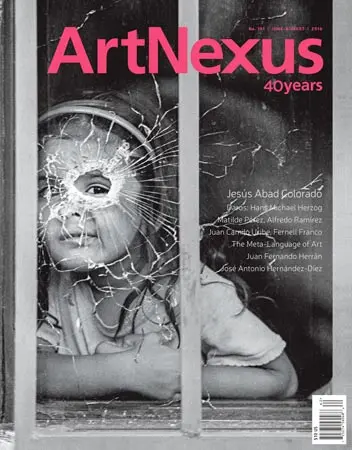
Like many Colombians, photographer Jesús Abad Colorado (Medellin, 1967) has experienced the violence in his native country directly. His own family suffered it, and the killing of his grandfather drove Abad Colorado to the realization that analyzing Colombia’s history with regards to the issue of violence required to look for its roots in the distant past. His decision to study Social Communication and Journalism at Universidad de Antioquia helped him value the importance of images, and, as he puts it, to “attempt writing the history of the country through photography.”
Without being a war correspondent, he gradually became a photo-reporter of Colombia’s armed conflict, telling stories that preserve memory, since a central preoccupation in his work is the forestalling of oblivion by means of presenting the suffering of victims and breaking through the insensitivity that is often caused by the reiteration of violent events. This is why as a documentary photographer he has recorded different aspects of the conflict, gathering visual testimonies of situations generated by events like forced migrations, the atmosphere in afflicted communities, and the ways in which these communities are able to resist and recover after such experiences. Abad Colorado not only bears witness to disaster; he also reveals the resilience of those who have lived through it.
One noteworthy aspect of his photography is its lack of interest in the morbid spectacle that sometimes arises from the registering of violence; rather, he seeks to document situations that prompt thought about the implications of the conflict. As a member of the Historical Memory Group, he says: “I don’t seek to provoke people into horror; I seek to have them reflect.” Thus, the arrival of his work in the museum serves, in his view, “the purpose of interrogating a nation about its memory.”
IVONNE PINI
IVONNE PINI
Issue Number: 101
Arte in Colombia: #147
Period: Jun 2016 - Aug 2016
You have 4 free articles remaining. Sign up for unlimited access.